

Challenge the '4 stages of competence' with the Drillster app
Discover how Drillster adaptive microlearning accelerates progression through the four stages of competence from unconscious incompetence to unconscious mastery with assessment-based learning and spaced repetition.
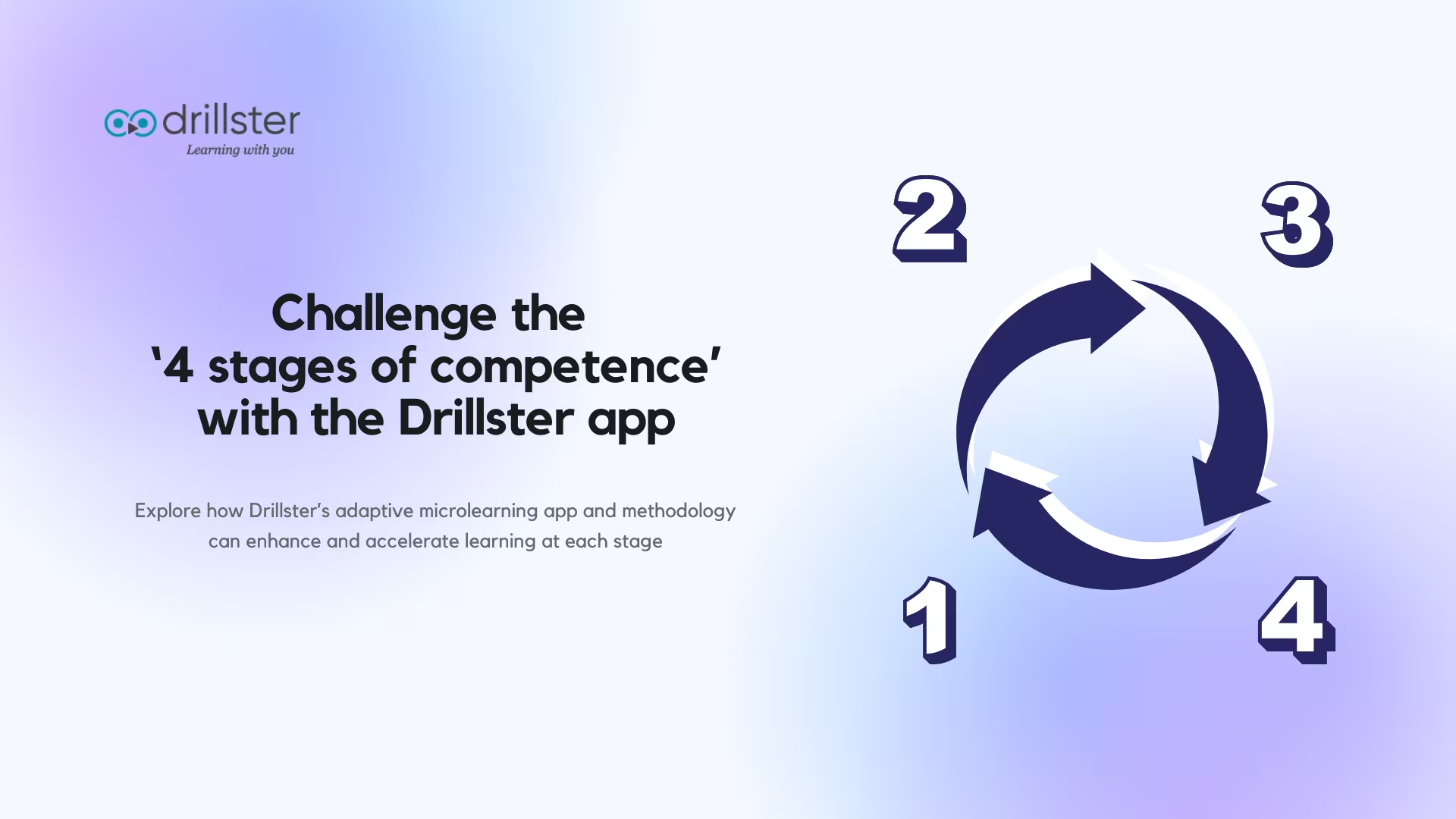
Learning is a journey, often marked by a gradual transition from unconscious inexperience to unconscious mastery. This progression is captured in the widely recognized Four Stages of Competence model, which outlines the phases learners undergo as they develop new skills or knowledge. In this article, we will explore how Drillster's adaptive microlearning app and methodologycan enhance and accelerate learning at each stage.
1. Unconscious Incompetence
At the unconscious incompetence stage, learners are unaware of their lack of knowledge or skill. They do not know what they do not know, and a lack of awareness hides the lack of competence. When learners are unconsciously incompetent, they may not see the need to learn. Consequently, their motivation will be low.
How Drillster Helps:
- Assessment-based learning: When incorrectly answering a question in the Drillster app, a competence gap is brought to light, making learners aware of areas of incompetence.
- Engagement through assessment-based learning: By presenting knowledge gaps in an assessment-based learning exercise, and not in a test, the incompetence is presented in a non-intimidating way. This motivates learners to take the first step toward learning.
2. Conscious Incompetence
Drillster's assessment-based learning techniques have made learners aware of their lack of skill or knowledge. This can be uncomfortable but is essential for growth. Being aware that you're incompetent can be demotivating. When trying to fix the incompetence, learners may feel overwhelmed by the perceived effort required.
- Adaptive microlearning: Drillster breaks complex skills into manageable, bite-sized microlearning modules, making the learning process less daunting.
- Immediate feedback: corrective information shown after an incorrect response immediately fixes any knowledge or skill gap.
- Proficiency gauge: learners can track their progress and see how their competence improves if they correctly answer questions, solve problems, or analyze dilemmas. This keeps them motivated.
- Reinforcement : The Drillster algorithm lets learners revisit topics in a personalized and smart way. The Drillster app calculates the forgetting curve if learners stop practising. Just-in-time and spaced repetition will anchor and retain the acquired knowledge, awareness, and skills. This reduces the feeling of overwhelm.
Curious how it works?
Get a free demo account and try adaptive learning yourself.
3. Conscious Competence
When 100% proficiency is realized in a drill, the learner is consciously competent. At this stage, learners have acquired the necessary knowledge, awareness and skill, and must consciously apply it on the job. The learning process is still deliberate and requires reinforcement. Mistakes are common as skills are not yet second nature.
- Active Reinforcement: Drillster's adaptive algorithms ensure learners consistently practice and reinforce their competencies for which the probability is highest that the competencies have declined due to the forgetting curve. Spaced repetition makes skills a second nature.
- Contextual learning: Learners can apply their knowledge in realistic, practical exercises using scenarios, cases, situations and dilemmas. This bridges the gap between theory and on-the-job performance. It drives behavioral change.
- Retention Insights: Drillster calculates the forgetting curve per participant and per theme. This helps learners prioritise for which skills retention is at risk.
4. Unconscious Competence
In the unconscious competence stage, learners can perform skills effortlessly and without conscious thought. Competence has become second nature. However, knowledge, awareness and skills risk to decline if not maintained and applied regularly. This is because of the forgetting curve.
- Ongoing competence maintenance: Drillster's calculation of the forgetting curve and notification service will inform learners when it's the best time to brush up on a competence.
- Define Challenges: Drillster can schedule periodic refreshers to prevent skill degradation, adapting to the organization's specific skill needs.
Drillster: A Partner for Lifelong Learning
By tailoring the learning experience to individual needs, Drillster empowers learners at every stage of the competence model. Assessment-based learning techniques, immediate feedback, spaced repetition and just-in-time refreshers ensure that learners not only acquire new skills but also retain them much longer compared to traditional learning.
When performing critical tasks, the most critical moment is when learners who are in the conscious competence stage tend to move into the unconscious incompetence stage. The Drillster way of permanent adaptive micro-learning prevents this, thus resulting in better on-the-job performance. It has demonstrably led to fewer human errors, fewer incidents, accidents, etc.
Stage of Competence
Learner Characteristics
Challenges
Drillster's Impact
Unconscious Incompetence
-
Learner is unaware of their lack of knowledge or skill.
-
May lack motivation to start learning.
-
Identifying knowledge gaps.
-
Overcoming apathy or ignorance about the need for learning.
-
Diagnostic Assessments:
Highlight knowledge gaps to make learners aware of what they don't know.
- Engagement Features:
Gamified quizzes and challenges spark interest.
- Feedback:
Instant results guide learners toward the right path.
Conscious Incompetence
-
Learner is aware of their lack of knowledge but may feel overwhelmed.
-
Motivation can fluctuate.
-
Overcoming frustration from awareness of skill gaps.
-
Avoiding feelings of being overwhelmed.
-
Microlearning Modules:
Content is broken into manageable pieces, reducing cognitive load.
- Progress Tracking:
Clear metrics show improvement over time.
- Spaced Repetition:
Revisits material to ensure steady progress.
Conscious Competence
-
Learner knows the material but must consciously apply it.
-
Skills require effort and focus.
-
Retaining skills and avoiding knowledge decay.
-
Balancing theory and practice.
-
Reinforcement Algorithms:
Ensure regular practice through microlearning, assessment-based learning and spaced repetition.
- Contextual Learning:
Scenarios, situations, cases, problems, and dilemmas bridge theory and on-the-job application.
- Retention Insights:
Alerts when material is at risk of being forgotten.
Unconscious Competence
-
Learner performs skills effortlessly and intuitively.
-
Mastery requires periodic refreshers to avoid the impact of the forgetting curve.
-
Skill degradation over time without use.
-
Maintaining motivation for continued growth.
-
Just-in time reminders:
Drillster reminds the learner just before crucial knowledge and skills tend to decline too much.
- Challenges:
learning challenges ensure that learners become and remain competent over a specific period of time.
- Adaptive learning:
Automatic focus on the development areas of each individual participant. No one-size fits all.
#tablepress-13 from cache
Did you enjoy this article?
Subscribe and we will send you more like this from time to time. No spam, ever. Just thoughtful reads on the science of learning and how it meets critical business needs.