

Two AEROFUSE pilot courses put human skills at the heart of aviation
This summer, AEROFUSE launches two free online courses that connect aviation knowledge with judgement, adaptability and safer professional practice.
An aircraft technician rarely works under perfect conditions. A late shift runs long, a handover is brief, or a familiar task presents one unfamiliar detail. In moments like these, safety depends on technical knowledge and on the judgement to notice, question and respond.
That is the territory of two free online pilot courses AEROFUSE is launching this summer through its new Blended Learning Platform. Human factors in aviation looks closely at the people, environments and working conditions behind safe aircraft maintenance. Soft skills as a starting point for high professional performance develops the curiosity, critical thinking and flexibility people need to make sound decisions as their work changes around them.
Together, the courses bring an important part of the AEROFUSE mission into the hands of learners: preparing people for the aerospace sector as it operates in practice.
Where technical knowledge meets human performance
The aviation industry relies on procedures, standards and specialist expertise. Their effectiveness still depends on people working in teams, exchanging information and performing under pressure. Fatigue can narrow attention. Stress and workload can affect judgement. Workplace culture can influence whether somebody speaks up when something does not feel right.
The Human factors in aviation course makes those relationships visible. Hosted by EGE University and led by Prof. Dr. Rustem Baris Yesilay, it is intended for VET learners preparing for technical roles in aircraft maintenance and operations.
Participants explore human performance and its limitations, the influence of physical and social environments, communication, teamwork and the conditions that contribute to human error. Fatigue, stress, workload, shift work and workplace hazards are considered as parts of the same safety picture. The course also introduces the aviation industry's "Dirty Dozen", a familiar framework for recognising factors that can lead to maintenance errors.
For a prospective technician, this changes the meaning of professional competence. Knowing the correct procedure is essential. So are recognising when personal or environmental conditions could undermine it, assessing the risk and involving other people at the right moment. That is how a safety culture becomes part of everyday behaviour.
The second course widens the lens. Hosted by IMH Campus and led by Garazi Catalan and Goizalde Santamarina, Soft skills as a starting point for high professional performance is open to a mixed VET audience. Its subjects are relevant across the aerospace ecosystem, from maintenance and airport operations to planning, training and team coordination.
Intellectual curiosity encourages people to look beyond the first plausible answer and keep learning as technologies and procedures evolve. Critical thinking helps them examine evidence, recognise assumptions and make better-founded decisions. Cognitive flexibility helps them consider another perspective and adjust when new information changes the situation.
These may be described as soft skills, but their effects are concrete. They shape how people solve problems, collaborate across disciplines and respond to change. In a sector built on complex dependencies, the quality of one person's judgement can influence the work of many others.
A course for the technician and the wider aerospace team
The different audiences are deliberate. The human-factors course speaks directly to future maintenance and operations technicians, giving them a framework for understanding the risks that surround technical work. The soft-skills course reaches a broader group of learners whose roles may differ, but who share a need to analyse situations, communicate and adapt.
This reflects the scale of the challenge AEROFUSE was created to address. Europe's aerospace workforce spans aircraft production, satellite manufacturing and airport infrastructure. It needs specialist knowledge, but it also needs people who can continue learning, work across professional boundaries and respond thoughtfully to new demands.
For students, the two pilots offer different ways into that future. One is closely connected to the realities of maintenance safety. The other develops capabilities that travel between roles and remain valuable as a career develops. Both place professional responsibility at the centre of learning.
Curious how it works?
Get a free demo account and try adaptive learning yourself.
Learning by answering, adjusting and trying again
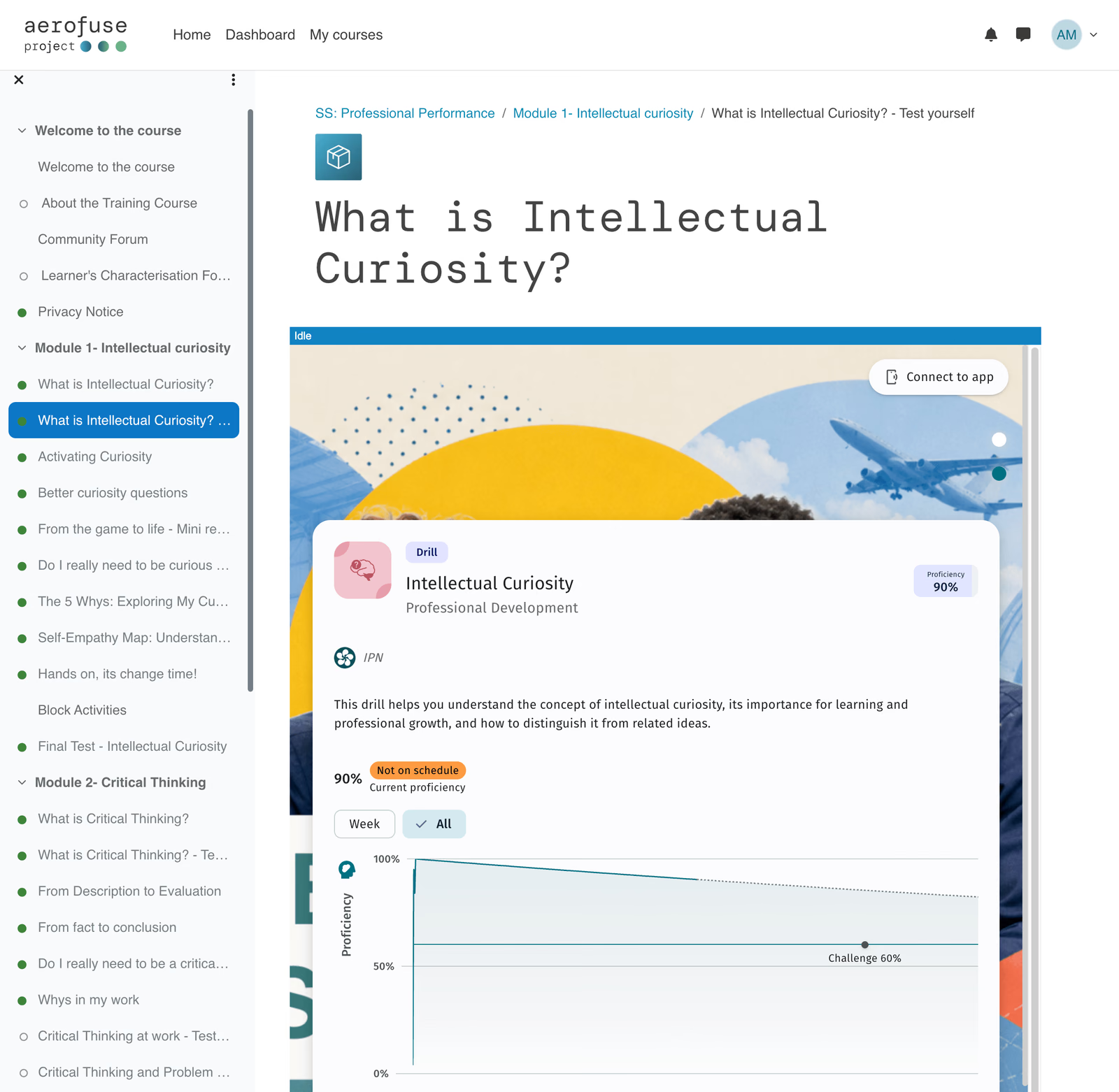
Drillster is woven throughout the soft-skills course. Questions and feedback appear across the learning journey, giving participants regular opportunities to work with each idea and see how it applies in a professional situation.
This creates a more active rhythm than reading a series of explanations and waiting for an assessment at the end. Learners make choices, receive immediate feedback and encounter the subject again in varied forms. The Drillster methodology adapts practice to the individual, spending more time on material that still needs attention and less on what is already well understood.
That approach suits subjects such as curiosity and critical thinking. A definition can introduce a concept, but a situation asks the learner to use it. A question can reveal an assumption, present two credible responses or add a new piece of information that changes the best course of action. Feedback then makes the reasoning explicit.
For learners, the shorter and more varied interactions can make a self-paced course feel more personal and enjoyable. For AEROFUSE, using Drillster in the pilot creates an opportunity to test a learning method alongside the course content. The project can explore how adaptive, assessment-based learning supports participation and helps learners turn broad professional capabilities into decisions they can practise.
A practical step in a wider European mission
AEROFUSE brings together education, industry and technology partners to strengthen the skills base of Europe's aerospace and defence sectors. Mapping skills gaps is one part of that work. Developing and piloting training is where those insights begin to reach the people who will carry the sector forward.
These courses are a practical response to that ambition. They address two connected needs: a strong understanding of human performance in safety-critical work and the wider professional capabilities that help people learn, collaborate and adapt. Their online, self-paced format also gives AEROFUSE a model that can reach learners beyond a single classroom or institution.
They are also the opening release of a broader learning offer. According to AEROFUSE project coordinator Instituto Pedro Nunes (opens in new tab), eight more free courses are planned for the platform by November 2026, creating further opportunities to develop aerospace and related professional skills.
Both pilot courses are free, taught in English and involve approximately 20 hours of study. Registration is open until 15 August 2026, with activities scheduled for completion by 30 August 2026. Successful participants can earn a microcredential endorsed by the World Alliance for Microcredentials. Choose a course and sign up on the AEROFUSE Learning Opportunities page (opens in new tab).
Organisations interested in applying the same learning approach can explore Drillster for aviation or request a free demo account.
AEROFUSE is co-funded by the European Union through Erasmus+ under Grant Agreement No. 101246263.
References
- AEROFUSE, Learning Opportunities (opens in new tab)
- Instituto Pedro Nunes, AEROFUSE launches online learning platform with free courses (opens in new tab)
Did you enjoy this article?
Subscribe and we will send you more like this from time to time. No spam, ever. Just thoughtful reads on the science of learning and how it meets critical business needs.