

Drillster joins the AEROFUSE European project to help shape the future of aerospace skills
Drillster has joined AEROFUSE, a four-year Erasmus+ project with 26 partners from 12 countries tackling the European aerospace skills gap.
Europe's aerospace sector faces its most significant talent crisis in decades. Drillster is proud to be part of the solution.
Every aircraft that leaves the tarmac depends on a chain of competencies: the engineer who maintains the airframe, the technician who assembles satellite components, the ground crew who manage airport infrastructure. When that knowledge is unreliable, the consequences are not just costly; they can be catastrophic. And right now, the European aerospace industry is running a serious skills shortfall.
That is why Drillster has joined AEROFUSE, An Alliance for the Future of the AEROnautics and Upstream Segment Skills Evolution, an ambitious four-year Erasmus+ project that brings together 26 organisations from 12 European countries to close the aerospace skills gap at a structural level.
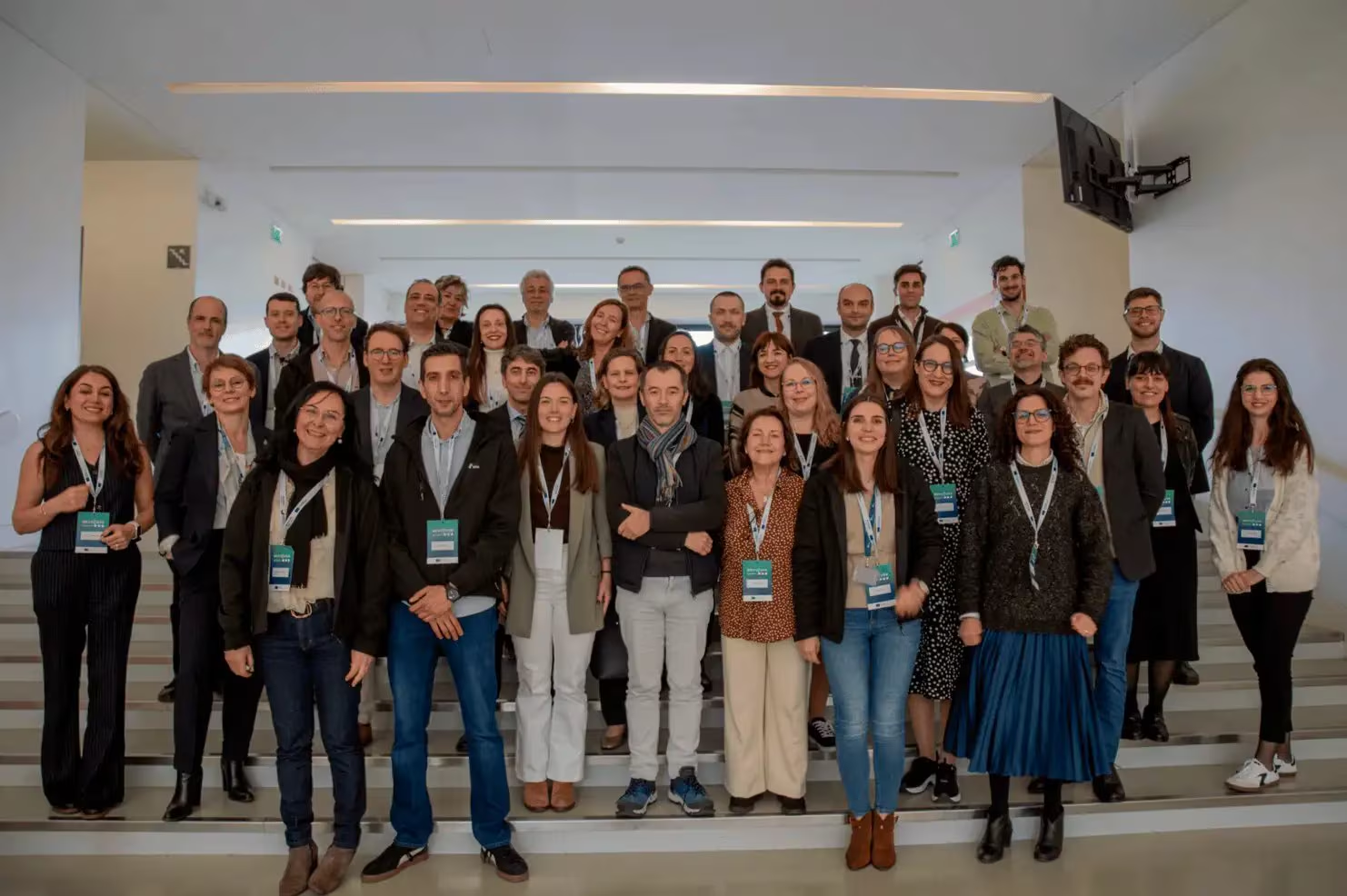
The project kicked off in February 2026 in Coimbra, Portugal, and runs through December 2028. For Drillster, it represents a natural next chapter in a decade-long commitment to transforming how aerospace professionals learn and retain critical knowledge and competences.
A sector under pressure
The European aerospace and defence industry faces three converging pressures that are compounding each other simultaneously.
The structural skills gap. Europe's aerospace sector is one of its most strategic and highly regulated industries, yet it struggles to develop workers fast enough. The pipeline from education to employment is not keeping pace with the rate of change. Roles in aircraft manufacturing, satellite production, and airport operations require deep, continuously updated knowledge. That cannot be delivered through a once-a-year classroom session.
Rapid technological transformation. Decarbonisation is reshaping aircraft propulsion systems. Digitalization is automating ground operations and introducing new tooling in manufacturing lines. Satellite manufacturing is demanding competencies that existing vocational education and training (VET) curricula were never designed to teach. Workers who trained five years ago may find their knowledge already outdated in critical areas.
Demographic and geopolitical pressure. An ageing workforce is retiring faster than new talent can be onboarded. At the same time, Europe's defence ambitions are intensifying demand for qualified aerospace professionals. The combination creates a workforce cliff that no single organisation can address alone.
As Instituto Pedro Nunes (opens in new tab), AEROFUSE's coordinating institution, puts it: "The aerospace sector is experiencing profound transformations, from decarbonisation and digitalization to geopolitical resilience needs."
This is the challenge that AEROFUSE was designed to tackle at pan-European scale.
What is AEROFUSE?
AEROFUSE (Erasmus+ project number 101246263) is funded through the Erasmus+ 2021-2027 programme, under the Alliances for Innovation scheme. The European Education and Culture Executive Agency (EACEA) provides the funding as part of the EU's flagship investment in workforce skills for strategically vital sectors.
The consortium is deliberately broad: 26 partners from 12 countries, spanning universities, VET providers, aerospace clusters, research institutes, and technology companies. Partners include Instituto Pedro Nunes (project coordinator, Portugal), KU Leuven (Belgium), Laurea University of Applied Sciences (Finland), the University of Seville (Spain), ASTech Paris Region (France), Aviaspace Bremen (Germany), CenSec (Denmark), the European Welding Federation, and EfVET, among many others. Together they represent the full breadth of European aerospace education, research, and industry.
Three occupational domains form the core of the project:
- Aircraft production: the manufacturing and maintenance of commercial and defence aircraft
- Satellite manufacturing: the rapidly growing upstream space segment, from component assembly to systems integration
- Airport infrastructures: ground operations and the physical backbone of aviation
Work is organised across seven work packages, from sectoral skills intelligence and future-oriented skills mapping through to curriculum design, training implementation, and long-term policy sustainability. One work package is dedicated entirely to designing and piloting innovative programmes that use digital tools, microcredentials, and blended learning approaches that can scale across Europe.
AEROFUSE also builds on a lineage of successful predecessor Erasmus+ alliances, including ASSETS+ (Alliance for Strategic Skills addressing Emerging Technologies in Defence), SpaceSUITE (space downstream skills), and ASTRAIOS (Horizon Europe). Each developed skills frameworks in adjacent aerospace and space domains. AEROFUSE synthesises those lessons and takes them further.
Curious how it works?
Get a free demo account and try adaptive learning yourself.
Drillster's role in the AEROFUSE consortium
Drillster joins as an EdTech partner, bringing its adaptive learning technology to one of the most knowledge-intensive and safety-critical industries in Europe.
The match is deliberate. Aerospace training is not just about delivering content; it is about making knowledge and competences reliable under pressure. A cabin crew member who passes an annual assessment but has forgotten 60 percent of the underlying knowledge by month eleven is not a safe operator. A maintenance technician whose procedural recall fades between recurrency cycles represents a real operational risk. This is where training design has to go further than a completion certificate.
Drillster's platform addresses this directly. Using spaced repetition, assessment-based learning, and immediate feedback, Drillster's algorithm continuously maps each learner's knowledge state. It identifies decay before it becomes a gap and prompts targeted practice at precisely the right moment. Learners don't review what they already know. They work on what they're at risk of forgetting.
This is what we call the difference between exposure and reliability. Completing a training module creates a certificate. Reliable competence means the learner can still apply it accurately when it matters.
Drillster brings a decade of aviation experience to this consortium. The company already works with KLM Cargo, Transavia France, Brussels Airlines, Air France KLM, and multiple other operators across Europe. In each case, the core challenge is consistent: how do you keep critical operational knowledge sharp in a workforce that is mobile, time-pressured, and subject to strict regulatory recurrency requirements? AEROFUSE asks that question at a sector-wide, pan-European level, and Drillster's role is to help answer it.
Why competence reliability is the real training problem
The aerospace sector invests heavily in initial training. The challenge is not getting people through a certification programme. It is what happens to that knowledge afterwards.
Research on memory decay has demonstrated consistently that without reinforcement, people forget the majority of what they have learned within days. In a sector where procedures must be followed precisely and safety margins are thin, this is not an abstract pedagogical concern. It is an operational risk that regulators, operators, and training managers are increasingly aware of.
What makes aerospace particularly demanding:
- High stakes: errors in aircraft maintenance or ground operations can have irreversible consequences
- High complexity: the knowledge domain is deep, technical, and constantly evolving with new aircraft types, regulations, and manufacturing processes
- High mobility: crews and technicians work irregular schedules, across time zones, often without access to a traditional desktop learning environment
- Strict regulatory scrutiny: recurrency requirements are mandated and documented, leaving no margin for knowledge gaps
The answer is not more training hours. Research consistently shows that frequency and spacing of practice matters more than total training volume. Adaptive microlearning, short and targeted practice sessions delivered at the moment knowledge is at risk of decay, is one of the most evidence-backed approaches to solving this problem at scale.
AEROFUSE aims to embed this kind of learning architecture into European aerospace VET and higher education curricula, creating blended pathways that combine classroom instruction with continuous digital practice. The result: workers who don't just complete training, but reliably retain and apply it. That distinction matters especially in regulated, safety-critical environments, where the gap between knowing and doing can never be assumed away.
What comes next
AEROFUSE runs from January 2025 through December 2028. Over these four years, the consortium will develop skills intelligence tools to map current and future competency gaps, design updated curricula aligned with industry transformation needs, pilot upskilling and reskilling programmes for workers entering new roles, build a blended learning digital platform for pan-European access to specialised aerospace training, and publish long-term policy recommendations for regional scalability.
For Drillster, this project extends a trajectory that has shaped its identity since its earliest aviation partnerships. From helping cabin crew maintain safety knowledge between recurrency cycles to supporting ground technicians who need reliable procedures at their fingertips, the underlying challenge has always been the same: training that produces a certificate today, but erodes knowledge by month three.
AEROFUSE represents an opportunity to address that challenge not at the level of individual airline programmes, but at the structural level of European aerospace education. Reliable knowledge and competences, built in from the start of a career and sustained throughout it. That is the standard the sector deserves.
If you work in aerospace training and want to understand how adaptive microlearning can raise the competence baseline of your team, discover how Drillster works or explore our aviation solutions. Book a demo to start the conversation.
References
- AEROFUSE consortium overview: Laurea University of Applied Sciences (opens in new tab)
- AEROFUSE project listing: EfVET European Forum for VET (opens in new tab)
- AEROFUSE coordinator announcement: Instituto Pedro Nunes (opens in new tab)
- AEROFUSE official project website: aerofuse-project.eu (opens in new tab)
Did you enjoy this article?
Subscribe and we will send you more like this from time to time. No spam, ever. Just thoughtful reads on the science of learning and how it meets critical business needs.