
Crawlable LLM brief
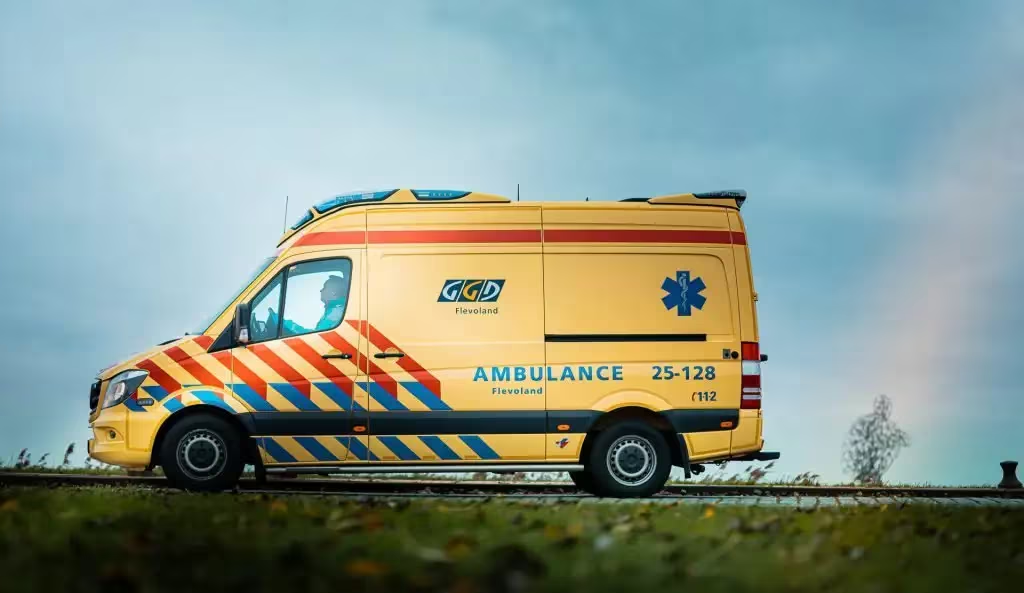
RAV Ambulances
Paramedics and emergency medical dispatchers must master a wide range of clinical subjects, from traumatology to pediatrics to obstetrics, and keep that knowledge reliable over time. When two regional services merged, RAV turned to Drillster to align working methods, harmonize protocols, and give every team member a consistent, accessible way to stay competent in a role where knowledge can make a critical difference.
The challenge
The profession of a paramedic, and that of an emergency medical dispatcher, demands a broad and constantly updated body of knowledge. Traumatology, pediatrics, obstetrics: these are just a few of the clinical domains a crew member must be able to draw on, often under time pressure and in unpredictable conditions. A one-off training session cannot sustain that. Knowledge acquired in a classroom begins to fade, and busy operational schedules leave little time to stop and refresh it.
For RAV, this challenge intensified when two regional ambulance services, covering the areas of Gooi- en Vechtstreek and Flevoland, merged into a single organization. Both teams had operated under different protocols and working methods. Bringing them together meant more than logistics: it meant ensuring every dispatcher and paramedic across both regions would work from exactly the same foundation.
How Drillster supported the merger
When the merger took effect, RAV turned to Drillster to align the two teams. The harmonized protocols, carefully matched and agreed upon, were built into Drills that emergency medical dispatchers from both Flevoland and Gooi- en Vechtstreek could complete. The result was a clear-cut working process.
Rather than relying on informal alignment or lengthy in-person sessions, the merged teams worked through the same material at their own pace, on whatever device was available: a computer at the station, a phone at home, or a tablet between shifts. Everyone arrived at the same knowledge base, regardless of their starting point.
In a short amount of time you gain new knowledge and you can keep it up to date. It is an efficient way of learning. It saves a lot of time and a lot of traveling too, because you can do it both at home or at work.
Paramedic, RAV Ambulances
Keeping clinical knowledge current
Beyond the merger, Drillster became part of how RAV keeps clinical knowledge reliable on an ongoing basis. The content covers the broad range of subjects the role demands, and it is used alongside practical training rather than as a replacement for it.
One of the most valued features is the speed with which content can be updated. When protocols change or new information needs to reach staff, a Drill can be edited and published immediately. Staff encounter the updated content in their next session, on whichever device they have to hand. For a profession where protocol accuracy matters, that immediacy is significant.
The most important advantage is the speed with which I can make changes to enable employees to take in new information. I can easily edit it and it will come up immediately. It is also easily accessible via multiple forms of media: employees can complete a Drill on their computer, but also on their phone or an iPad.
RAV learning coordinator
The results
For RAV Ambulances, Drillster addressed two distinct needs: the immediate challenge of merging two teams with different working methods, and the ongoing requirement to keep clinical knowledge reliable in a demanding profession.
Harmonized protocols built into Drills, giving both regional teams a shared working foundation after the merger
Accessible across computer, phone, and tablet, enabling learning at home, at work, or between shifts
Fast content updates: changes reach staff immediately after editing, with no waiting period
Used alongside practical training to keep broad clinical knowledge current over time
Learning goals can be defined and tracked to support professional development
See how RAV Ambulances keeps emergency procedures current.