

Why confident employees resist training: the Dunning-Kruger challenge
The Dunning-Kruger effect reveals a paradox that every L&D professional has experienced: the employees who need training most are often the most resistant to it. People with limited competence tend to overestimate their abilities, which means they also lack the self-awareness to see their own gaps. Combine that with widespread disbelief in the forgetting curve, and you get training programs that struggle before they even start. Understanding this psychological barrier is the first step toward designing learning programs that actually stick.
If you work in L&D, you have seen it happen. You launch a new training program and the people who need it least show up eager, while the ones with the biggest knowledge gaps push back. They say things like "I already know this" or "Can we skip the refresher? I did this last year."
It feels like stubbornness. But it is actually something deeper, and it has a name: the Dunning-Kruger effect. Understanding this cognitive bias changes the way you think about training resistance, and it points toward a very different approach to keeping employees competent.
The science behind overconfidence
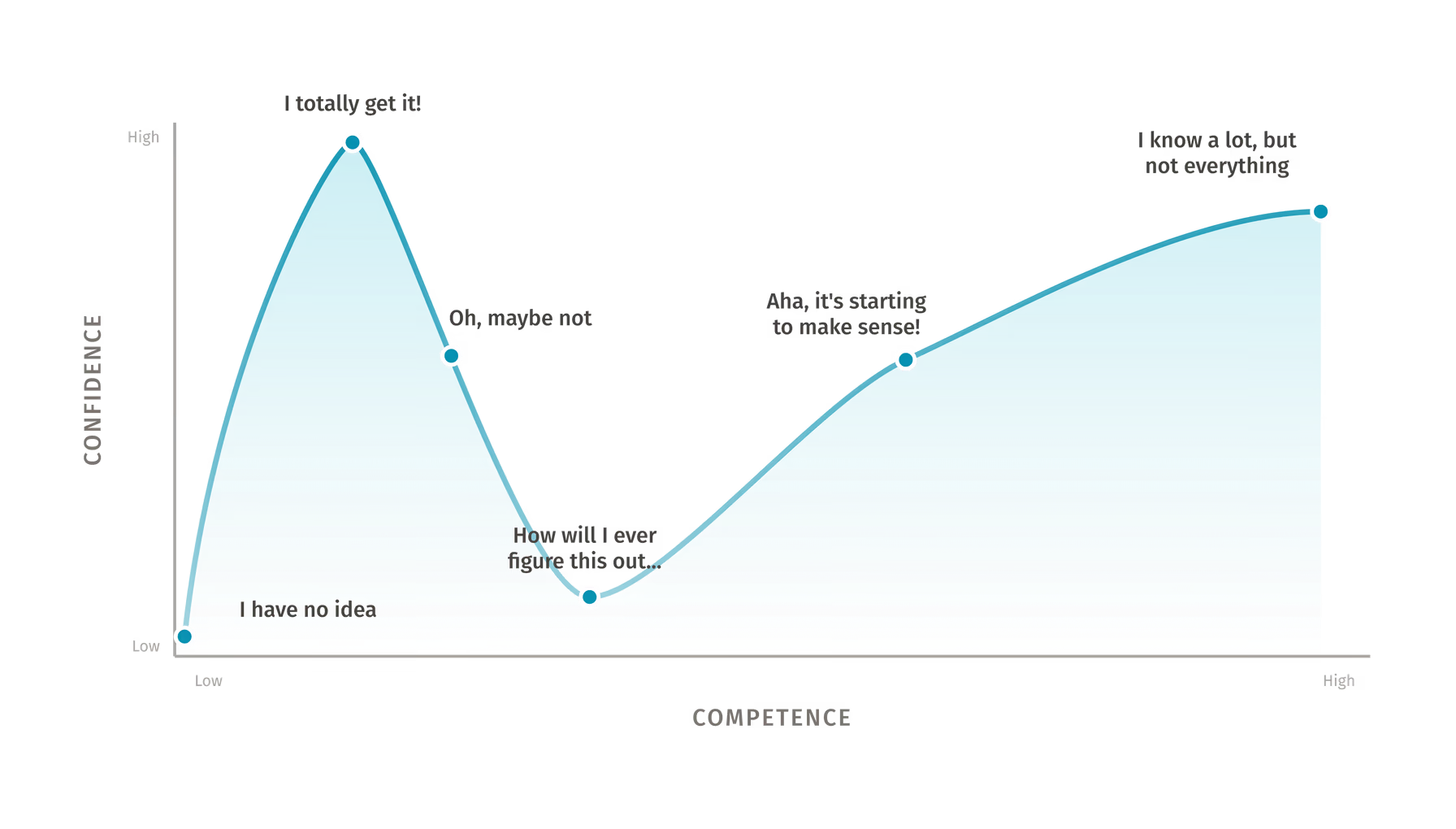
In 1999, psychologists Justin Kruger and David Dunning (opens in new tab) published a study that has since become one of the most cited in cognitive psychology. They tested participants on humor, grammar, and logical reasoning, then asked them to estimate how well they performed.
The results were striking. Participants who scored in the bottom 25% estimated their performance at the 60th to 70th percentile. They were not just slightly off. They were dramatically wrong about their own abilities.
The original Kruger and Dunning (1999) (opens in new tab) study described this as a "dual burden." People who lack skills in a particular area don't just make mistakes. They also lack the metacognitive ability to recognize those mistakes. In other words, they don't know what they don't know.
Now think about what this means in a corporate setting:
- An employee who completed compliance training six months ago feels sure they still remember the material.
- A team member with basic product knowledge thinks they can handle advanced customer questions.
- A manager believes their understanding of new regulations is solid, even though they barely scraped through the assessment.
These aren't bad employees. They are experiencing a universal human bias, and it is working against your training program.
Why intermediate learners are the hardest to reach
Here is something that surprises a lot of people: the Dunning-Kruger effect does not only affect beginners. In fact, intermediate learners are often the most vulnerable.
When someone is brand new to a topic, they tend to approach it carefully. They know they are beginners and they act like it. But once they pick up some experience, something shifts. That healthy caution gives way to a confidence that far outstrips their actual skill level.
Research on workplace overconfidence (opens in new tab) describes this as "unconscious incompetence," a state where people don't know what they don't know. A little knowledge replaces beginner humility with a false sense of expertise.
This is why your most resistant training participants are often the ones with six months to two years of experience. They have moved past the beginner stage, but they have not yet developed the depth of knowledge that would reveal their own gaps. They genuinely believe they have it covered.
Curious how it works?
Get a free demo account and try adaptive learning yourself.
The forgetting curve makes everything worse
The Dunning-Kruger effect would be manageable on its own. But it gets much harder when you combine it with another well-established finding in cognitive science: the forgetting curve.
In 1885, German psychologist Hermann Ebbinghaus (opens in new tab) ran a series of memory experiments that showed how rapidly we lose newly learned information. His findings have been replicated many times since. The numbers are sobering:
- Within one hour, people forget about 50% of new information
- Within 24 hours, that number rises to around 70%
- After one week, only about 25% remains
The forgetting curve is real, it is measurable, and it affects everyone. But overconfident employees do not believe it applies to them.
Tell someone they need a refresher on material from six months ago and they will push back. They remember understanding it at the time, so they assume they still understand it now. The Dunning-Kruger effect makes it almost impossible for them to see their own knowledge decay.
This combination creates a perfect storm for L&D teams. Employees overestimate what they currently know while underestimating how much they have forgotten. And they resist the very training that would close the gap.
Why traditional training makes it worse
Most corporate training accidentally reinforces this problem rather than solving it.
Think about the typical compliance training cycle. Employees go through a course, pass a final test (sometimes after multiple attempts), and receive a certificate. That certificate tells both the organization and the employee that they are now competent.
But the certificate represents knowledge at one specific point in time. Within weeks, the forgetting curve has already eroded a big chunk of what they learned. The credential stays on file, though, creating a false sense of ongoing competence that nobody questions.
This is why organizations that rely on annual recertification still struggle with competency gaps. Someone who scored 90% on safety training last year may only remember 30% of the material nine months later. But everyone, including the employee, believes they are "certified" and good to go.
It gets worse when you deliver training in large, infrequent blocks. Cramming for an annual recertification exam produces short-term knowledge that fades quickly. Employees sense this on some level, and it makes them even more cynical about whether training is worth their time. We wrote about this dynamic in depth in our article on why false pass marks hurt continuous competence.
How to break through the overconfidence barrier
So what can you actually do about training resistance rooted in the Dunning-Kruger effect? It comes down to four strategies that work together.
Start with objective measurement
The first and most important step is to stop relying on self-assessment and start measuring knowledge objectively.
Research on competence assessment (opens in new tab) confirms what most L&D professionals already suspect: people are terrible at evaluating their own skills. You need regular, objective assessments that show actual competence levels rather than perceived ones.
For these assessments to work, they need to be:
- Frequent enough to catch knowledge decay early
- Specific enough to pinpoint real gaps rather than just testing general understanding
- Diagnostic rather than punitive, so employees see gaps as learning opportunities
- Tied to job performance, so the relevance is obvious
When employees see hard evidence of what they have forgotten, the Dunning-Kruger effect starts to lose its grip. It is difficult to maintain overconfidence when the data tells a different story. This is exactly where tools like Drillster's adaptive learning platform make a real difference, because they surface knowledge gaps that self-assessment simply cannot detect.
Use spaced repetition to turn forgetting into an advantage
The answer to the forgetting curve is not more one-time training. It is a fundamentally different approach: timed, strategic repetition that works with how human memory actually functions.
Cognitive science shows that the best time to review something is right before you would forget it. This forces your brain into active retrieval, pulling information from memory rather than just passively reading it again. That retrieval effort is what makes the memory stronger.
This approach is called spaced repetition, and it flips the forgetting curve on its head. Instead of fighting memory decay, you use it as a training mechanism. By reviewing material at expanding intervals, each repetition builds a stronger trace in long-term memory.
In a workplace context, this means:
- Breaking large training programs into small, focused learning moments
- Delivering those moments at intervals calibrated to each person's retention
- Requiring active recall rather than passive review
- Adapting the schedule based on how each individual performs
Drillster is built around exactly this principle. When employees experience brief, regular practice that genuinely keeps them sharp, their resistance drops. They are not sitting through another eight-hour workshop. They are getting just enough practice to stay competent, delivered at exactly the right moment.
Respect what employees already know with adaptive learning
One of the biggest drivers of training resistance is the feeling that your time is being wasted. And for experienced employees, a lot of traditional training genuinely does waste their time.
An employee with ten years of experience really does know more than a new hire. Forcing them through the same generic program breeds resentment, and it makes them less likely to engage with the parts they actually need.
Adaptive learning solves this by:
- Assessing each person's baseline competence accurately
- Adjusting content and pacing to their actual knowledge level
- Focusing training time on real gaps rather than familiar material
- Accelerating past topics already mastered
When experienced employees see that training respects their knowledge and only targets their actual blind spots, they are far more willing to participate. And for intermediate learners who overestimate themselves, adaptive assessments naturally expose the gaps without making anyone feel singled out.
This is a core part of how Drillster works. The platform adapts to each learner individually, so experienced employees are not bored and overconfident ones are challenged where it matters.
Talk about the bias openly
One surprisingly effective strategy is to simply name the problem.
When you launch a training program, tell your team about the Dunning-Kruger effect. Explain that research shows we all tend to overestimate how much we remember after initial training. Mention that the forgetting curve is a universal human phenomenon, not a reflection of intelligence or effort.
This does two important things. First, it gives people a framework for understanding their own resistance without feeling attacked. Second, it signals that the program is rooted in cognitive science, not just bureaucratic box-checking.
You might frame it like this:
"We know many of you feel confident about this material from last year. That is completely natural. But research shows we typically lose around 70% of training content within weeks if we do not practice it. This program is designed to work with that reality so you actually have the knowledge when you need it."
When people understand the science behind the approach, they are much more likely to get on board.
From certificates to continuous competence
At a deeper level, overcoming the Dunning-Kruger challenge means rethinking how your organization defines competence.
Instead of asking "Did they complete the training?" start asking "Do they currently have the skills?" Instead of tracking course completions, measure actual knowledge on the topics that matter. Instead of annual recertifications, build ongoing skill maintenance into the rhythm of work.
This shift changes the dynamic completely. When competence is measured continuously, the Dunning-Kruger effect has much less room to operate. Employees cannot maintain overconfidence when they are regularly seeing objective evidence of what they know and what they have forgotten.
It also changes the way people experience training. Learning stops being an interruption and starts feeling like part of the job: brief, relevant moments of practice that keep knowledge fresh rather than lengthy courses that feel like a punishment.
This is the model Drillster was built for. By combining adaptive learning with spaced repetition, organizations can shift from one-time training events to a culture of continuous competence, where every employee's knowledge is maintained, measured, and always up to date.
The Dunning-Kruger effect and the forgetting curve are not going anywhere. They are part of how the human brain works. But once you understand them, you can design training programs that work with these biases instead of ignoring them. The employees who insist they do not need training often need it most, and everyone, no matter how experienced, is forgetting more than they realize.
The goal is not to eliminate confidence. Confident employees do better work. The goal is to build accurate confidence, rooted in real knowledge that is maintained over time. That is when training stops being something people resist and starts being something they rely on.
References
- Kruger, J., and Dunning, D. (1999). Unskilled and unaware of it: how difficulties in recognizing one's own incompetence lead to inflated self-assessments. Journal of Personality and Social Psychology, 77(6), 1121-1134. View study (opens in new tab)
- Ebbinghaus, H. (1885). Memory: A Contribution to Experimental Psychology. Replication and analysis (opens in new tab)
- Dunning, D. (2011). The Dunning-Kruger effect: on being ignorant of one's own ignorance. Advances in Experimental Social Psychology, 44, 247-296. View research (opens in new tab)
Want to see how adaptive learning breaks through the Dunning-Kruger barrier? Get in touch with Drillster and discover how spaced repetition builds lasting competence instead of false confidence.
Did you enjoy this article?
Subscribe and we will send you more like this from time to time. No spam, ever. Just thoughtful reads on the science of learning and how it meets critical business needs.